
 The officeOn your route
Step 1 · Copy and paste
The same information goes in twice.
A customer request becomes a quote, then a job, then an invoice. Someone copies the details at every step and checks that nothing changed along the way.


Operations software and automation
When jobs, customer details and updates live in different places, someone has to carry the work between them. Too often, that someone is you. We connect the tools you already use and build what is missing.
Booked as a Fit Call. The $249 counts toward your build when you sign the written scope within 30 days.
Not ready for a paid call? The Warm-Up Lap is free: 15 minutes with Gavin Brooks.
Your part is one 60 to 90 minute Fit Call, one written scope to approve, and feedback on working versions. We handle the rest. Your Fit Call is with Gavin Brooks, who has spent two decades in operations: leadership in AT&T authorized and Apple-certified retail, owning a last-mile delivery company, and working in dealership lot operations.
Your team has already found the gaps. We help close them.
The officeOn your routeStep 1 · Copy and paste
A customer request becomes a quote, then a job, then an invoice. Someone copies the details at every step and checks that nothing changed along the way.
 The crewOn your route
Step 2 · Phone tag
The office needs to know where a job stands. Your crew needs the latest instructions. You end up passing messages between people who already have enough to do.
 The ownerOn your route
Step 3 · Numbers by hand
The information exists, but it is scattered across spreadsheets, inboxes and software. Getting a clear picture means rebuilding it by hand.
You have a business that runs and people who know their work. You need the systems around them to keep up.
 Owners and operatorsOn your route
Step 4 · Who we work with
We work with owners and operations leads coordinating people, jobs, vehicles and customers. Your team might be on a dealership floor, at a customer’s property or moving between locations.
We are probably not the right fit if you want a website and nothing else, if nobody owns the process day to day, or if the work is a single task with no systems behind it. If that is you, we will say so and point you somewhere better.
 Paddock20On your route
Step 5 · Where it started
Gavin Brooks came to software through operations: selling the connectivity behind phones and tracking devices, owning a delivery fleet and working in automotive. He has been the person choosing the tools and the person relying on them when the day gets busy.
That experience shapes Paddock20. We ask how the work gets done, listen to the people doing it and build around the parts that matter.
 Paddock20On your route
Step 6 · A young company
Paddock20 is a young company, and you can check the work. The Test Track runs on a real car and real invoices. Every build starts from a written scope you approve.
You own the app, its credentials and its repository. Our own tools inside it can be used only in that app, and your agreement covers the handover of accounts and licenses.
 Nashville, TNOn your route
Step 7 · Talk to us
Write to [email protected], call Amy at (615) 551-3500 or use the contact page. We reply within 1-2 business days.
We look at how the job moves, who touches it and where it slows down. Then we work out what needs to change.
 What you haveOn your route
Step 8 · Configure
Sometimes the right system is already in place. It needs a better setup, a clearer workflow or a simpler way for your team to use it.
 Your toolsOn your route
Step 9 · Connect
When your existing systems can handle the job, we connect them and automate the handoffs between them.
 What is missingOn your route
Step 10 · Build
When the available software does not fit, we build a focused application around your operation.
The recommendation should make sense for the problem, the people using it and the cost of keeping it running.
Three services, each with its starting price. The rest are one step further down.
 Five jobsOn your route
Step 11 · What you are buying
Each one comes with the work that shows it.
 The officeOn your route
Step 12 · Service
Connect intake, quoting, scheduling, follow-ups and reporting. Replace repeated copy-and-paste work with a process that sends decisions to the right person.
 The teamOn your route
Step 13 · Service
Give your team a clear place to manage jobs, assets, customers or the information your existing tools cannot handle together.
 Your callersOn your route
Step 14 · Service
Answer incoming calls, collect the details and route the next step around your business rules. Where your scheduling system supports it, the agent can book appointments too.
Amy answers our own line. Call (615) 551-3500 to hear one.
 The businessOn your route
Step 15 · More services
The rest of the work, each with its own page.
Client work first, then the event site and our own tools. Each one has its own page with the detail.
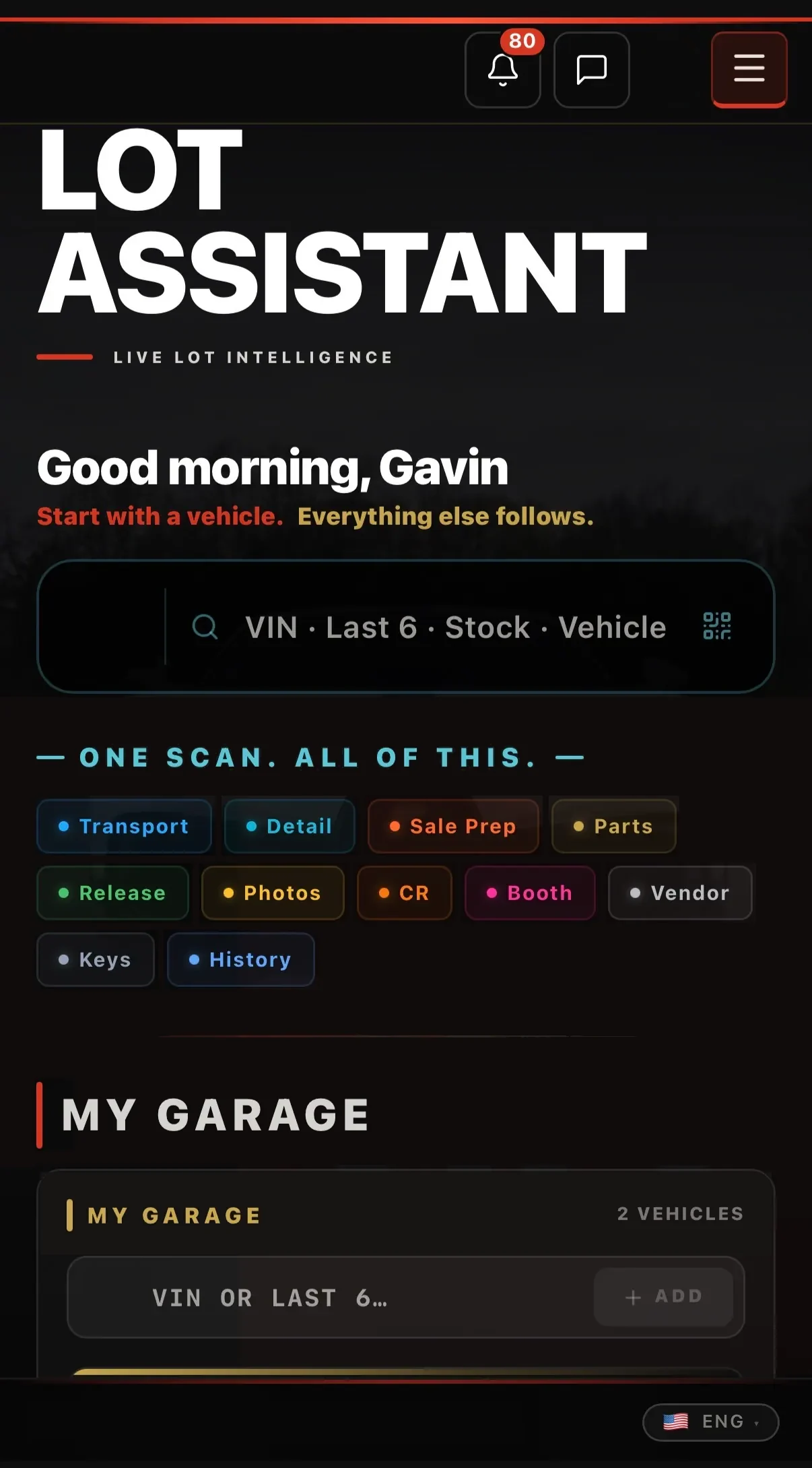
Step 16 · Client work · Ran in production
Built for an exotic and luxury automotive retailer and wholesaler. Its floor staff handled vehicle intake, transfers and releases from their phones.
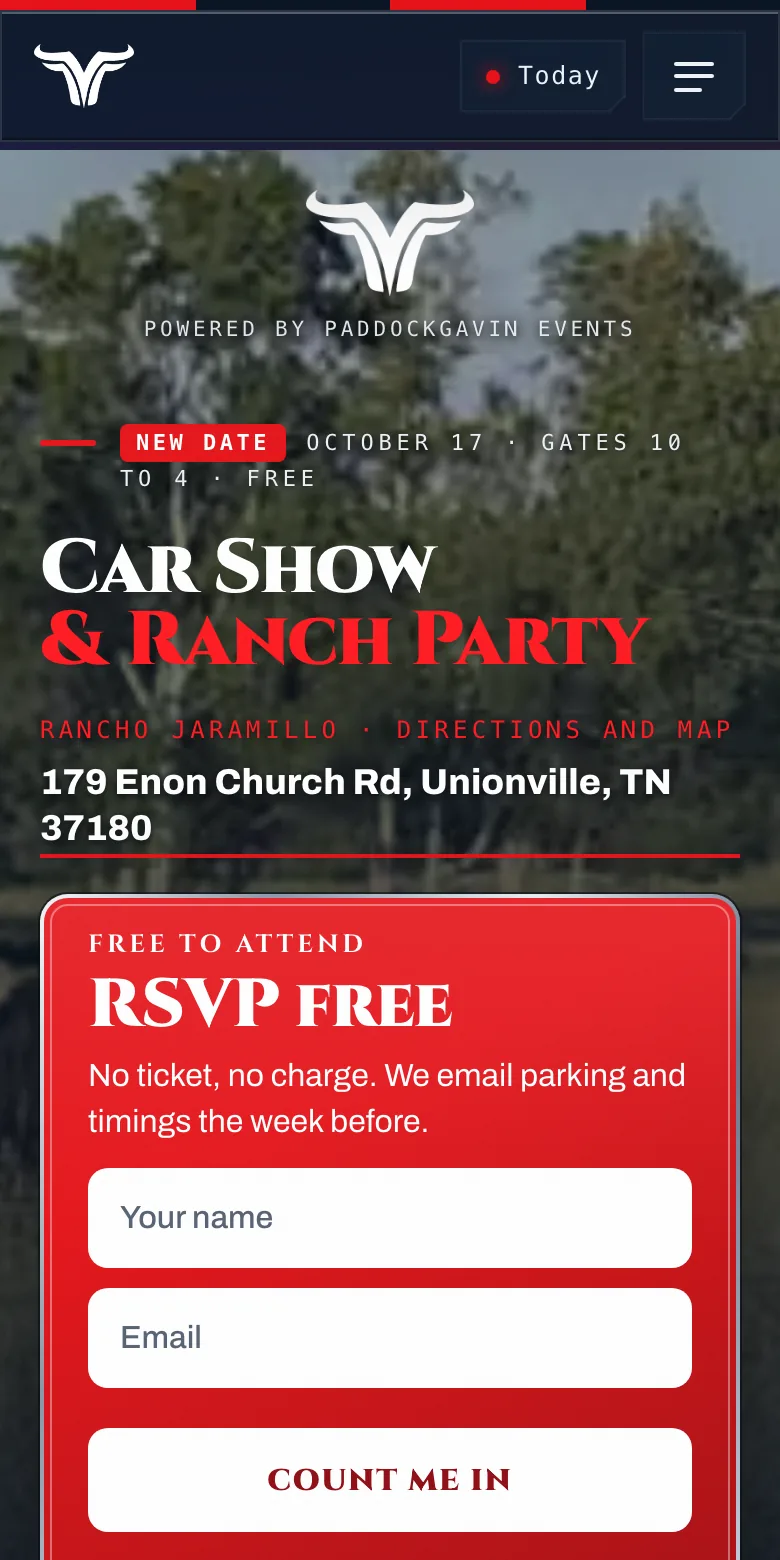
Step 17 · Event platform
One site for guest RSVPs, show-car entries, vendor booths and sponsor checkout, with every part of the event working from the same records.
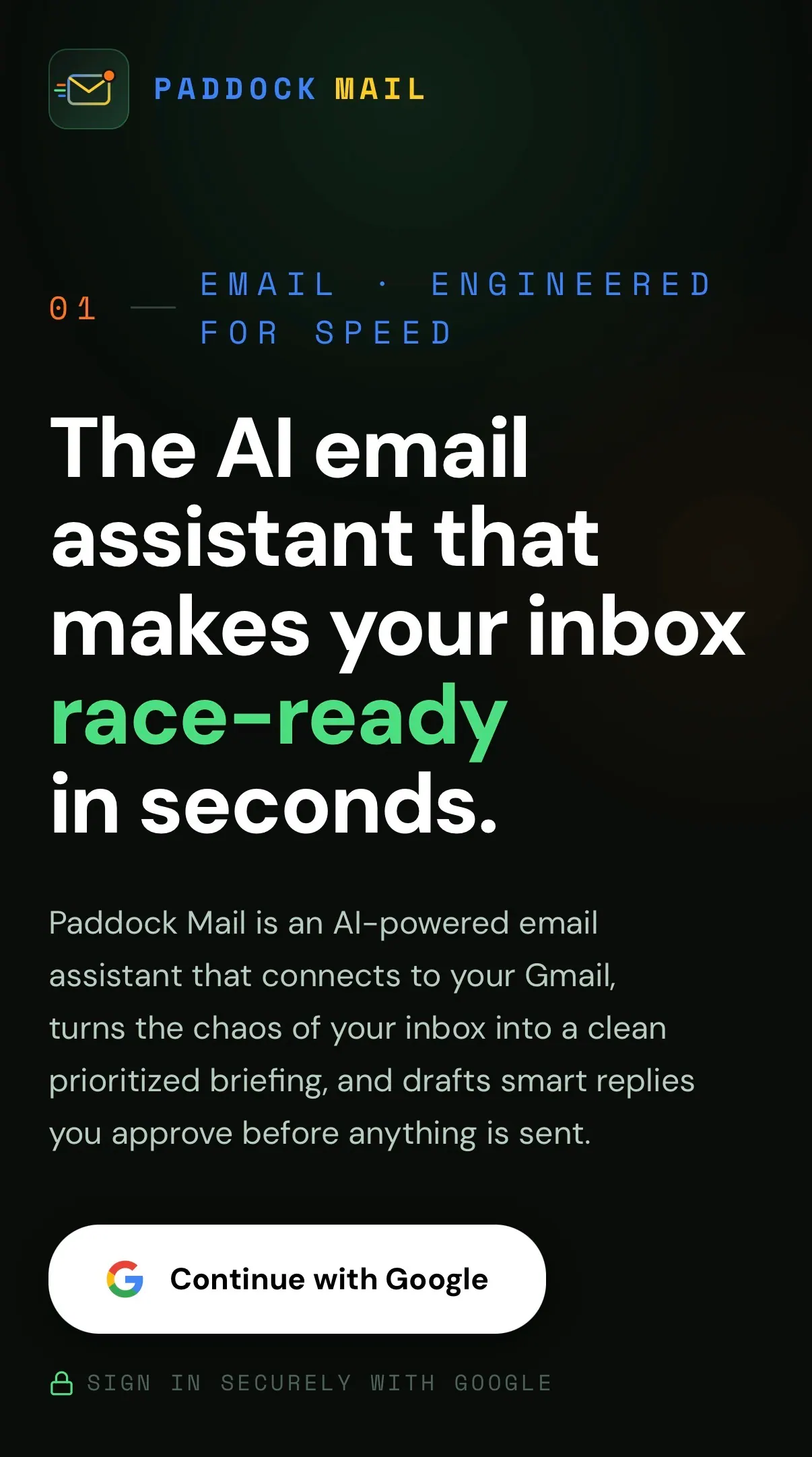
Step 18 · Paddock20 product
An email tool built for our own inbox first. It sorts incoming messages, drafts the routine replies and clears out the junk, with no rules to set up.
 Our labOn your route
Step 19 · Vehicle testing lab · Ongoing study
Our vehicle testing lab, blending cars and tech. Right now it is a Model Y study: miles and charging come from the car, and costs from real invoices.
 Paddock20 productsOn your route
Step 20 · More of the work
SupercarIQ names a car from a photo and prices it from auction results. iGot Receipts keeps the paper trail on a car. RAIL Redline rewrites a draft in your voice.
 The craftOn your route
Step 21 · How the pages are made
Live examples you can change, with the CSS and the readability rules behind them.
 Our productsOn your route
Step 22 · Built in the open
An interactive map of our products and how they connect. Client builds appear by what they do, not by name.
A good starting point is one process that costs you time every week, depends too heavily on one person or keeps slipping between tools.
 FreeOn your route
Step 23 · Talk it through first · free
Fifteen minutes on a video call with Gavin Brooks, free. You describe what you need, and he says whether a Fit Call makes sense next, or points you somewhere better.
 Your first stepOn your route
Step 24 · Look at the problem
The Fit Call is a paid working session with Gavin Brooks on one real workflow. We go through the process, the people involved and what you have already tried.
The $249 counts toward your build when you sign the written scope within 30 days.
 Your scopeOn your route
Step 25 · Put the recommendation in writing
Within two to three business days you receive a written scope: the approach we recommend, the assumptions behind it and the price. If a build needs more investigation before it can be priced, we say what still needs checking and agree on the next step.
 The buildOn your route
Step 26 · Agree on the build and put it into use
Once you approve the scope, we build to it and test the work against it before your team puts it to use. Ongoing care is available separately.
 OngoingOn your route
Step 27 · After launch
The Paddock20 Retainer is monthly, with no minimum term. The client portal shows the work as it happens.
Short courses, a mastermind in Nashville, tools you can try now and the Wireframe Digest.
 LearnOn your route
Step 28 · Paddock Courses
Short courses on putting AI to work in a business: $49 per course, $799 for all, and several are free.
 NashvilleOn your route
Step 29 · AI Mastermind
The Nashville AI Mastermind, Fall/Winter 2026. The date is not set yet; the page says what a seat includes.
 Self-serveOn your route
Step 30 · Tools to try
Scope a build with RAIL, sketch an app concept, score your operation free in about 90 seconds, or get a free audit with the three fixes worth doing first. RAIL Redline starts with a 7-day free trial.
 GuidesOn your route
Step 31 · Read
Guides on business software, automation and agentic engineering, from the work itself.
Five to start with. The rest are on the questions page.
 AnswersOn your route
Step 32 · Questions
Not always. Often the first step is to check what your current software can already do, or to connect the systems you use. We start by understanding the work so we can recommend a sensible approach.
Often, yes. We review what you use, how it stores information and what integrations it supports. Access, licensing and technical limits become part of the recommendation.
No. Automotive is an important part of our experience and portfolio. We also build for service businesses with similar operating needs: coordinating teams, moving information and keeping track of work.
Your agreement defines ownership of the custom application, its source code and the access delivered to you. Third-party tools keep their own licenses and fees.
Workflow automation runs $749 to $4,999. Custom software runs $5,000 to $7,000 for a focused first version and $9,000 to $12,000 or more for a broader application. Each build is quoted in writing, including recurring costs such as hosting and third-party services. The Fit Call is $249. The $249 counts toward your build when you sign the written scope within 30 days.
The next step
Tell us where the work gets stuck, who has to deal with it and what you use today. That is enough to start a useful conversation.
No obligation to commission a build.
Not ready to book?
Take the Wireframe Digest instead.
What shipped, what it cost and what broke, one issue at a time. Unsubscribe from any issue.